Forecasts for 2050
Some facts, some speculation, some dreaming about the future and what could be.

I think we spend too much breath focused on the past and immediate future. Stories of how careers were forged and companies built. Predictions for the next quarter, the newest model, or the latest unhinged presidential tweet.
Venture capital in its early days was all about swashbuckling adventure - science and engineering turning the rocks beneath our feet into malleable programmable magic was the origin story of Silicon Valley. At Nebular, we want to capture that early spirit as best we can.
So we are launching Forecasts 2050: An interview series that looks beyond the news cycle and short term hype, focusing instead on what the world might look like in twenty five years’ time, what we hope goes right or wrong, and what it will take to get there. First episodes to come in the spring with folks like Tyler Cowen, Scott Aarsonson, Devon Zuegel, Matt Clifford and more.
We do not seek a future returned to the art-deco nostalgia of the roaring 20s. We look to a novel future, experienced and shaped in our lifetimes. Regardless of specific technological advancements, things have already been set in motion that cannot be undone. We must live with these changes, tackling them sooner rather than later. Demographics cast a long shadow over all else.
We also aspire to a world bigger than the present problems of our day. A world where we push the frontier into the stars, place reins on the ecological and geographic forces that we have, for centuries, prodded unplanned with sharpened sticks, and one in which the concept of disease fades from common memory.
The future will not be all sunshine and flowers. Our darker instincts are equally as enabled as our better angels when technological progress trots onwards. But the good will outweigh the bad, and to understand our coming future we must explore both.
To achieve this we will go beyond just the world of tech. 25 years ago our industry sat at the fringes of the global economy - now, other than Saudi Aramco, all of the top 10 largest companies in the world are in tech. Politics, Energy, Healthcare and Conflict will all shape how people building technology companies in the 21st century must orient themselves.
We believe standing for something will be increasingly differentiating for companies and investors in the sea of slop and increasingly zero sum attitudes that await over the horizon.
Below, you’ll find the Nebular 2050 Forecast. Across 11 core themes with aims of expanding to more. We envision this as a living document: one that will fuel ongoing debate and conversation about the direction our world is heading, the forces shaping it, and the individuals and organisations, both commercial and governmental, doing their part to create a more interesting and more abundant future. Perhaps you are one of them, whether you know it yet or not.
Demographics
As we move from majority-young to majority-old society in the West, we will grapple with the financial implications of supporting huge elderly populations with a shrinking human workforce. This will change almost every aspect of the world we have known this past 100 years.
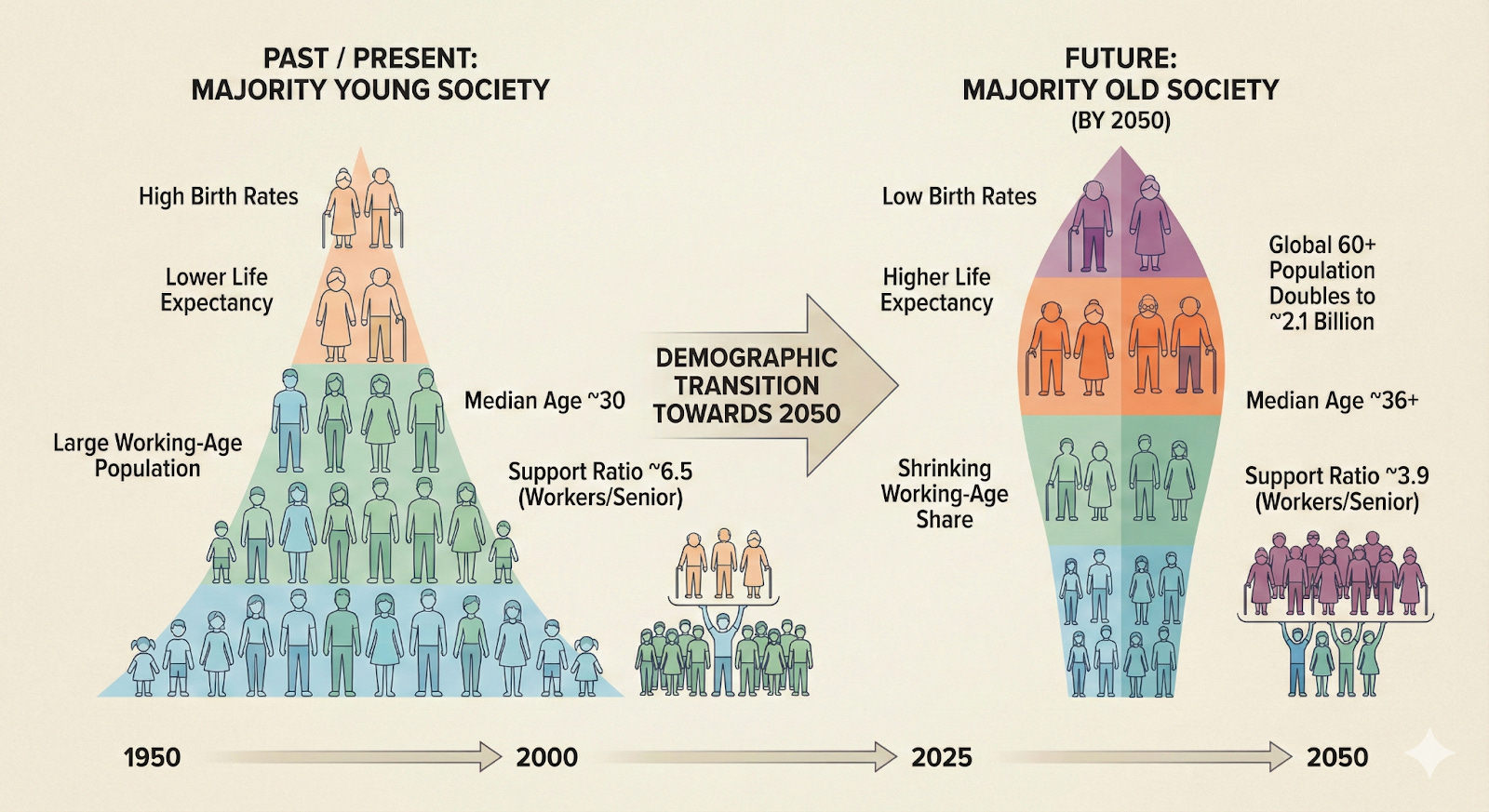
By 2050, the world’s population pyramid will invert. The number of people over 60 will double to at least 2.1 billion, and global fertility rates will fall below replacement levels. Two-thirds of this elderly population will live in low or middle-income countries. Europe and East Asia will contract, while sub-Saharan Africa will surge. India will overtake China as the world’s most populous country, while Italy and Japan shrink by double digits. Nigeria’s population will surpass that of the United States.
The ratio of people older than 65 relative to the working-age population, also known as the old-age dependency ratio, will rise sharply to as much as 80 elderly dependents per 100 working people in some countries.
And these are all conservative estimates. The UN has quietly lowered its population projections in recent years, and we anticipate that the population decline will be even greater than expected. There are scenarios where we round trip back to 1960s level populations within a century.
By 2050 the writing will be on the wall for the severity of this trend. Expect trillions to be spent on incentives and technology to reverse it. Trillions more on transitioning the economy and society to this new reality. Fertility will be a battleground of novel science and questionable morals as people ask the question: if we could create an artificial womb, should we?
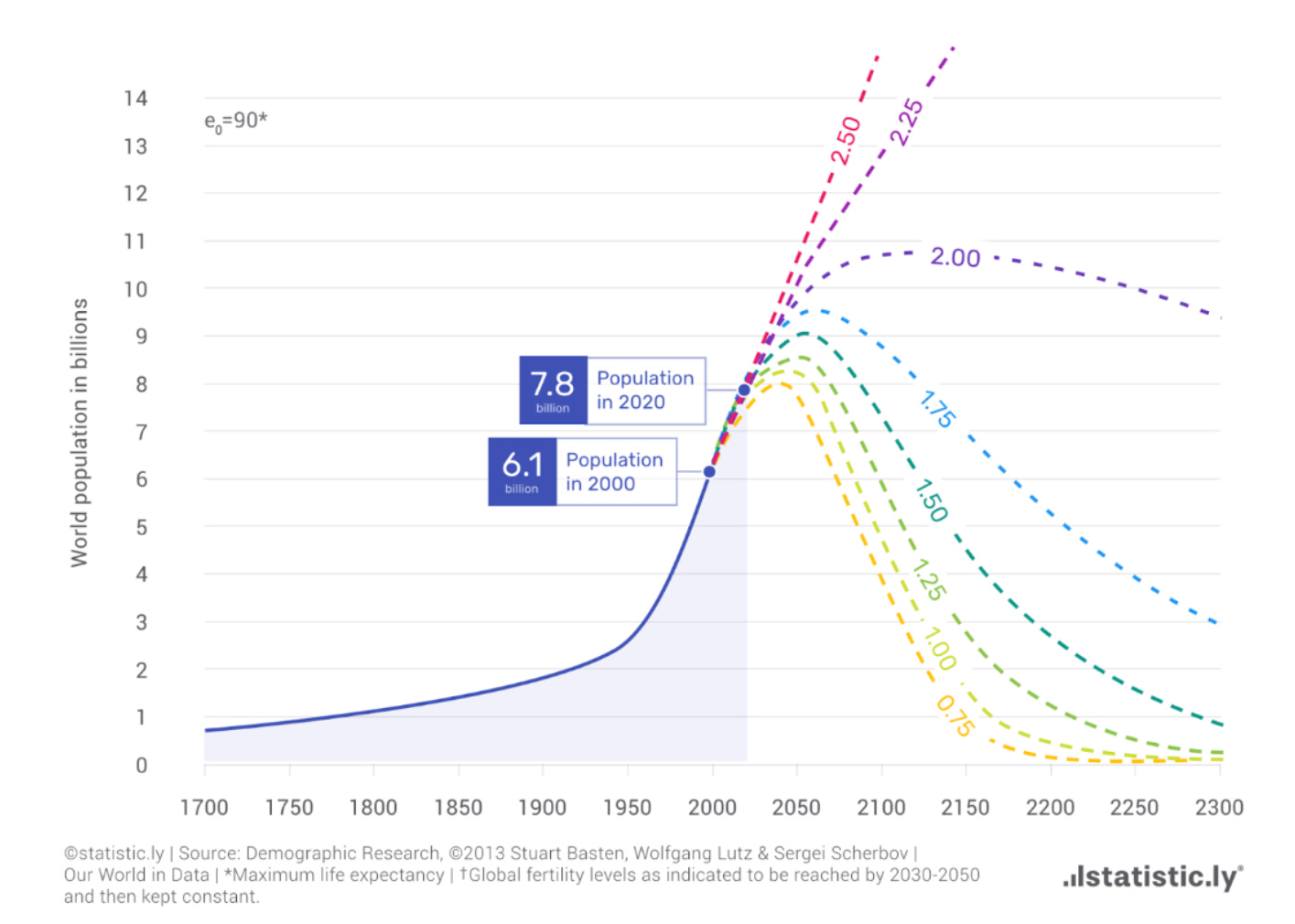
The most important graph you’ll see this decade. Each line extrapolates world population for a different fertility rate. The global fertility rate today is 2.2, and falling. (Highlighted by our friends at Unruly)
Global Financial Markets
Financial nihilism will continue to drive trends in consumer behavior, with attempts to reign in public deficit spending largely failing and concerns about inflation perpetually around the corner.
In 2050, global debt burdens will be so substantial that they will offer the first major shakeup in the global monetary order since the introduction of the Euro or China’s admission to the WTO. Student debt default rates over 20% in the United States offers a preview of the debt crisis we will encounter in the next 25 years. Aging populations in tandem with ever increasing global debt burdens will exert tremendous downward pressure on economic growth. The debt-GDP ratio has already risen 54% in the United States since 2000, and the Wharton School of Business projects that the U.S. debt-GDP ratio will rise to 225% by 2050 from 123% today.
The unsustainable burden placed on the working-age population to pay off these debts will become increasingly apparent. In light of this dismal financial picture, we anticipate that financial nihilism will continue to drive trends in consumer behavior. In the absence of a clear path to prosperity, people will ape into escape routes. Hypergambling will become commonplace and innovations on perps, zero-day options trading, prediction markets, sports betting, and other gamified schemes will be the cutting edge of finance “innovation”.
Crypto will affirm itself as an eternal financial primitive, with Bitcoin, Ethereum & Solana in particular continuing to reign supreme. Stablecoins will likely be co-opted by existing power structures to be leveraged by the old-fashioned rent seeking TradFi guard in different clothes. As AI takes over a larger share of global economic activity, almost all of this world of agentic finance will be onchain. Innovation onchain also will shield many people from autocratic governments, profligate central banking policy and create more avenues for global entrepreneurship. The multi-polar world will open up corridors of varied regulation and challenging enforcement. The financial frontier will remain, as always, in the grey zone.
Health
The demand for senior institutional care will more than triple as life expectancy increases. Transmitted, cancerous & genetic diseases will be largely eliminated.
Based on conservative estimates of demographic changes, the demand for institutional senior care will rise by 330% by 2050. We expect the demand for these services will be even greater as people live longer. A shrinking population of clinicians relative to patient volume will push more care to be delivered by AI and Robotics, each of which will be widely adopted in clinical settings.
AI-driven diagnostics and wearables will identify certain diseases before symptoms appear. Alongside vaccines, this will entail the elimination of many transmitted diseases. AI will also help us design drugs customized for individuals but at great cost, eliminating most cancers and genetic disease. Access to these top of the line treatments will be a new political battlefield for spend-conscious governments worldwide. AI will also manage almost every aspect of healthcare administration, reducing costs but raising questions around who is responsible for ever more digital decisions.
Granular awareness of our health will drive a massive swing in consumer spending habits. Aversion to microplastics will be akin to removal of lead from life in the 20th century. Deeper understanding of the causes of brain disease like sleep disruption will drive investment in sound proofing homes and sleep science. Longevity medicine will extend the quality of our later life but, for most, the upper bounds of living to between 90-100 years will remain firmly in place.
Drug-resistant bacteria could kill up to 10 million people annually by 2050, with the potential for this rate to get much worse. Diabetes will become a defining disease of the 21st century with more than 1 in 10 people afflicted globally. Most cases will be located in South America and the Middle East. Governments will attempt to deploy cost-effective measures to drive positive behavioral health changes at scale. GLP-1s may be introduced to some drinking water sources as a necessary public health measure, just as Fluoride was in the 50s.
AI & Robotics
Everything that can be automated will be, and everything that cannot will rapidly increase in value.
Traditional job markets will erode as automation subsumes repetitive labor: robots for physical tasks, AI agents for cognitive ones. Manufacturing and routine office roles will become increasingly obsolete. Since physical tasks make up more than 50% of working hours for 40% of the US workforce, and the figures in the developing world are even more stark, global unemployment could reach 25% or higher. Teleoperation will accelerate global job shifts, streaming roles over the airwaves instead of shipping them overseas.
Roles that won’t be replaced will be those mandated by law, demanded by human preferences or be sufficiently complex, dynamic and niche to be unappealing to the peddlers of automation. Pilots will fly airplanes, pharmacists will write prescriptions, bartenders will say hello and musicians with soul will perform live concerts. In a world of abundant automation, craft will trade at a premium. Many of those who lose their jobs to AI will realise entrepreneurship has never been more accessible - local players will spring up competing in every software category and businesses that couldn’t exist before due to labor constraints will begin to flourish.
By mid-century, AI will permeate every dimension of human decision-making. Even without AGI, people will outsource their decisions to AI advisors like therapists and designers that understand them better than they understand themselves.
Robotics will become ubiquitous in public life. 50%+ of all traffic in the west will be autonomous, improving global logistics and changing how we think about road accidents. Robotic assistants will become as common as smartphones. Autonomous fleets will manage agriculture, logistics, emergency response, construction, manufacturing, and transportation. Drones as we know them today will be an everyday part of life, delivering groceries and medicines to the elderly in their homes. Silent propulsion systems will be a crucial technology in achieving buy-in for this change.
And all of this will have unprecedented (positive?) economic implications. When the cost of growing food, building infrastructure, and moving things trends toward zero, what does society look like? What are we able to do that we had never dreamed we could? What do cities, buildings, and restaurants start to look like? Will energy be the ultimate bottleneck?
Robot friends and AI companions will become part of the social fabric. At the same time, surveillance infrastructure will expand into omnipresent monitoring networks, causing many sections of society to revolt against the AI Big Brother.
Cities & Infrastructure
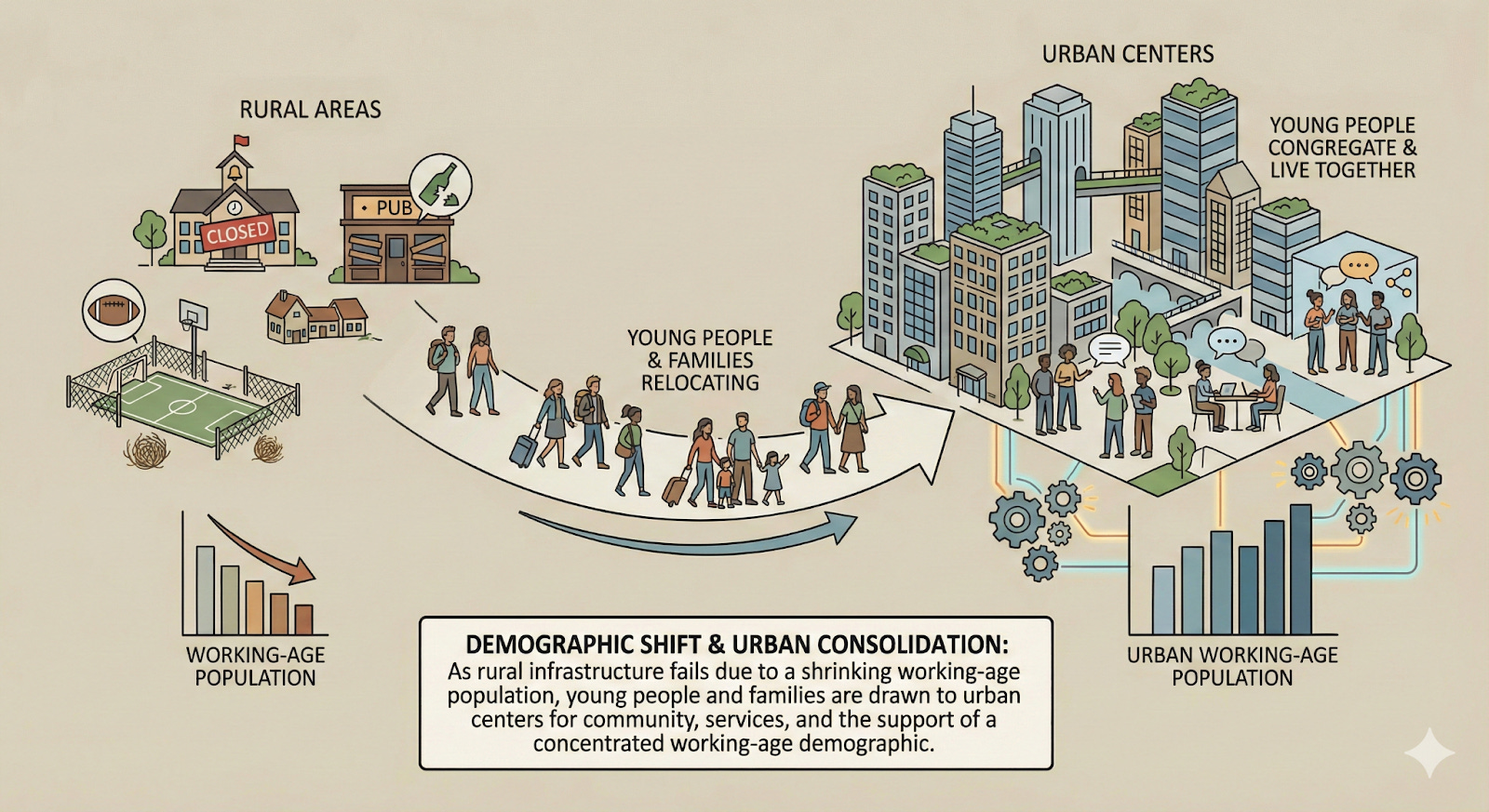
The housing crisis will ease as populations age and decline across many countries. Megacities will emerge across Africa, the Middle East, and India. Urban cores will become hubs for the young as there isn’t sufficient density in rural settings for amenities like bars, restaurants, and schools.
By 2050, 70% of humanity will live in cities, 2.5 billion more people than today. Megacities will rise across Africa & India, some teeming with nearly 40 million people. Massive investment will be required, with much of the capital coming from the UAE and Saudi Arabia. India & Africa’s enormous young labor pool will be tapped for the one of the biggest infrastructure build outs in history both at home and abroad. The conversation of ‘cost competitive’ between humans and robots varies across geographies, specialism and scale. In young societies the scales still tilt human.
As the population of working-age people dwindles in the developed world, young people will want to live with other young people. Rural areas will see mass closures of schools, bars, and sports facilities, forcing young families to relocate to urban centers where the working age population supports the infrastructure we have been accustomed to growing up in a majority-young society.
Outside the young urban hubs housing crises will ease due to less aggregate demand. Cost of new builds will be driven down by automation & robotics in construction - but challenges for policy makers will be brutal as the mistake of the 20th century to tie homeownership and price appreciation to the average citizen’s primary method of wealth creation is laid bare as lacking generational staying power.
Commercial real estate will be repurposed for a variety of uses, but much of it will be left to dereliction. Urban design will contend with climate shocks and the integration of autonomous vehicles into daily life. Policing will change dramatically in these environments as initially surveillance is welcomed, then fought against. Robotics will become a part of law enforcement, partly due to the small numbers of young recruits for many standard policing roles.
Conflict
We will live in a multipolar era where states make unilateral decisions about going to war, and rivalries that have been dormant for the past century will go from luke-warm to hot.
The historical aberration of Pax Americana is coming to an end, and with it a return to an era in which there is no dominant superpower to impose a unipolar world order. The adversaries of the current world order - China, Russia, Iran, North Korea, and Venezuela - will initially welcome the return to a multipolar world, and then compete amongst themselves and other rising powers to fill the power vacuum left by the United States. The winners of this game of thrones will have earned their positions for the same reason America won WWII. In the words of Walter Russell Mead, “we were better at organizing productive powers for destruction than our enemies were.” The wars of the future will be fought across digital and physical realms by cybersoldiers, drones, and, as always, infantry in trenches. Drone swarms, standoff weapons (& their interceptors) and the scaling of autonomous logistics will be what ultimately wins. The ability to produce weapons at scale will be crucial, just as it was when America scaled up industrial output during WWII.
Mutually Assured Destruction will still prevent direct great power wars, but there will continue to be regional conflicts and proxy wars worldwide as states compete to ensure their survival. Multilateral institutions like the UN will fade into irrelevance as we enter an increasingly hostile world, and peace deals will be brokered by the relevant state actors. Regions currently thought of as secure and politically stable may become grounds for proxy wars. The rise of ambiguously aligned regional brokers like Singapore, the UAE, Switzerland, Vietnam, and others who invest in hard power despite their size will be one of the biggest emerging geopolitical trends of the next 25 years. The EU, forced by an increasingly intransigent US on its left and ever hostile Russia on its right, begins to set itself on a much more innovative trajectory led by emerging power players like Poland. In a back to the future moment, we will see the rise of modern charter companies. Privateers, PMCs and even humanitarian aligned forces will operate globally.
Conflict, unfortunately, continues to be a massive driver of innovation and change.
Geopolitics
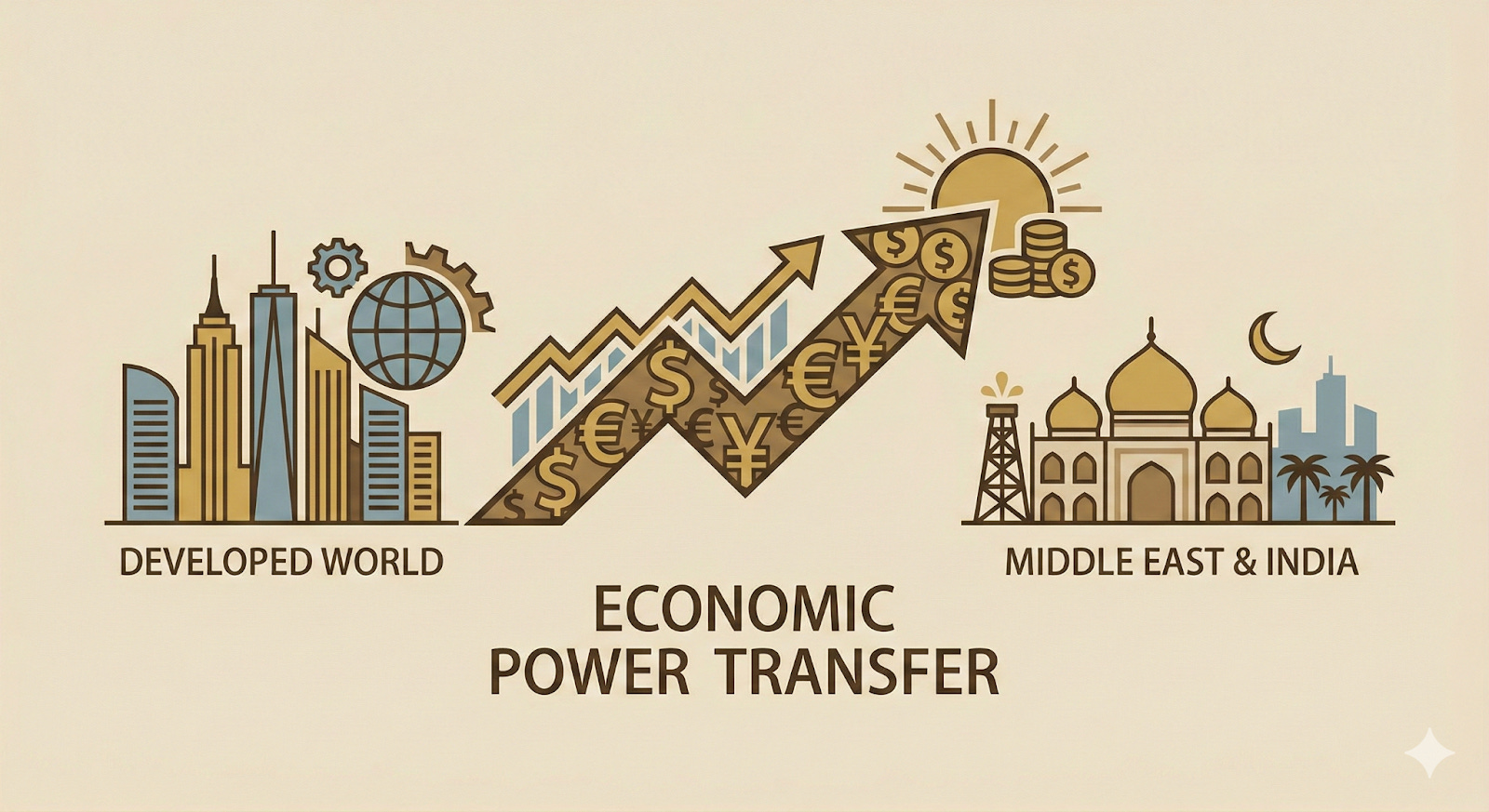
Shifting global alliances and the demand for immigrants will reshape the geopolitical landscape.
By 2050, the generational turnover of leaders like Modi, Xi, and Putin will reshape the global political landscape.
The global center of economic growth will fully pivot from the developed world to Africa, the Middle East, and India due to their young, growing populations. These changes lead us to expect that Europe will forge an alliance with China. Economic warfare between China and America will elevate India, the UAE, Indonesia, and Singapore as attractive trade corridors. China’s influence across Africa will intensify, leveraging the growing workforce there, while the Middle East also benefits from favorable demographic trends that give it a very enviable position for the next 25 years. Robotics will keep the US & China well ahead in absolute GDP terms but growth, and its power to attract capital, will be fuelled by the young and rising consumption.
The question of the UK rejoining the EU remains uncertain: commit to a Singapore/Taiwan style economic model or go full Gaullist with massive state intervention in the growth sectors of the economy? The transition from welfare state policies to focusing on growth causes massive upheaval across the giants of Europe. Is the future of the EU seen today in Greece & Poland?
Nearshoring of manufacturing is the biggest question on policy makers’ minds. Namely, which supply chains can be trusted and which must be brought onshore for security or competitive reasons? Everyone searches for their TSMC equivalent.
Climate & Energy
Millions of new refugees will be created by extreme weather events due the changing climate and technology will offer a path to resolving this crisis, just on a longer timeline that we would hope.
By 2050 global temperatures are projected to rise by at least 5° F (~2.8° C), and sea levels by 10-12 inches (~.3m). Coastal cities like Miami, Boston, San Francisco, and Seattle will face episodic flooding, compelling vast investments in new climate-resistant infrastructure.
Climate migration will reshape demographics. Millions will flee drought-stricken zones and inundated river deltas, accelerating the global refugee crisis. Rising temperatures will alter agricultural belts, pushing food production northward. Heat related deaths continue to skyrocket in the summers, providing a boon for Northern and Southern countries in temperate climates and continuing to fuel the one truth in investing: there is always money in HVAC.
The political challenges caused by the cost of energy in states that have pursued climate goals for the past decade will reach fever pitch. In a multipolar world, competitiveness will rear its ugly head once again and countries will fight to modernize their power grids and reduce cost per kW/hr. Most will do so by taking advantage of continued massive improvements in solar efficiency and battery technology, but at the price of handing a huge geopolitical win to China who will own that supply chain. Other countries will race to catch up with massive state investment being required.
We will make significant inroads in tackling these challenges through Solar Reflective Technology (SRT) and advances in carbon sequestration and carbon removal technologies, but it will take until the end of the century to fully decarbonise our way of life.
Science & Technology
Technological and scientific breakthroughs will blur the line between man & machine, and new discoveries in physics will reshape our understanding of the universe
By 2050, new technology will have reshaped every domain of human life. Quantum computing and AI will open up new possibilities in materials science and our understanding of the universe. Post-quantum cryptography will become essential to national sovereignty as classical cryptography is made redundant. BCIs will come into the mainstream, and the line between human & machine will begin to blur. Genetic engineering will come first to pets, but will be on the cusp of acceptance for humans. If you could make yourself glow in the dark, would you?
AI will be a key participant in scientific discovery, with the first green shoots of progress already appearing in this field today. Creativity will remain a human endeavor and major breakthroughs will be the product of brilliant minds alongside powerful models.
In physics, we will still be searching for a theory of everything, even as an enormous particle accelerator outdates the Standard Model of particle physics and tremendous amounts of computation expand our experimental horizons. The James Webb Space Telescope will reach the end of its useful life, likely having found the first truly Earth-like planets in our local galactic neighbourhood and debunked the Big Bang Theory.
The Space Economy
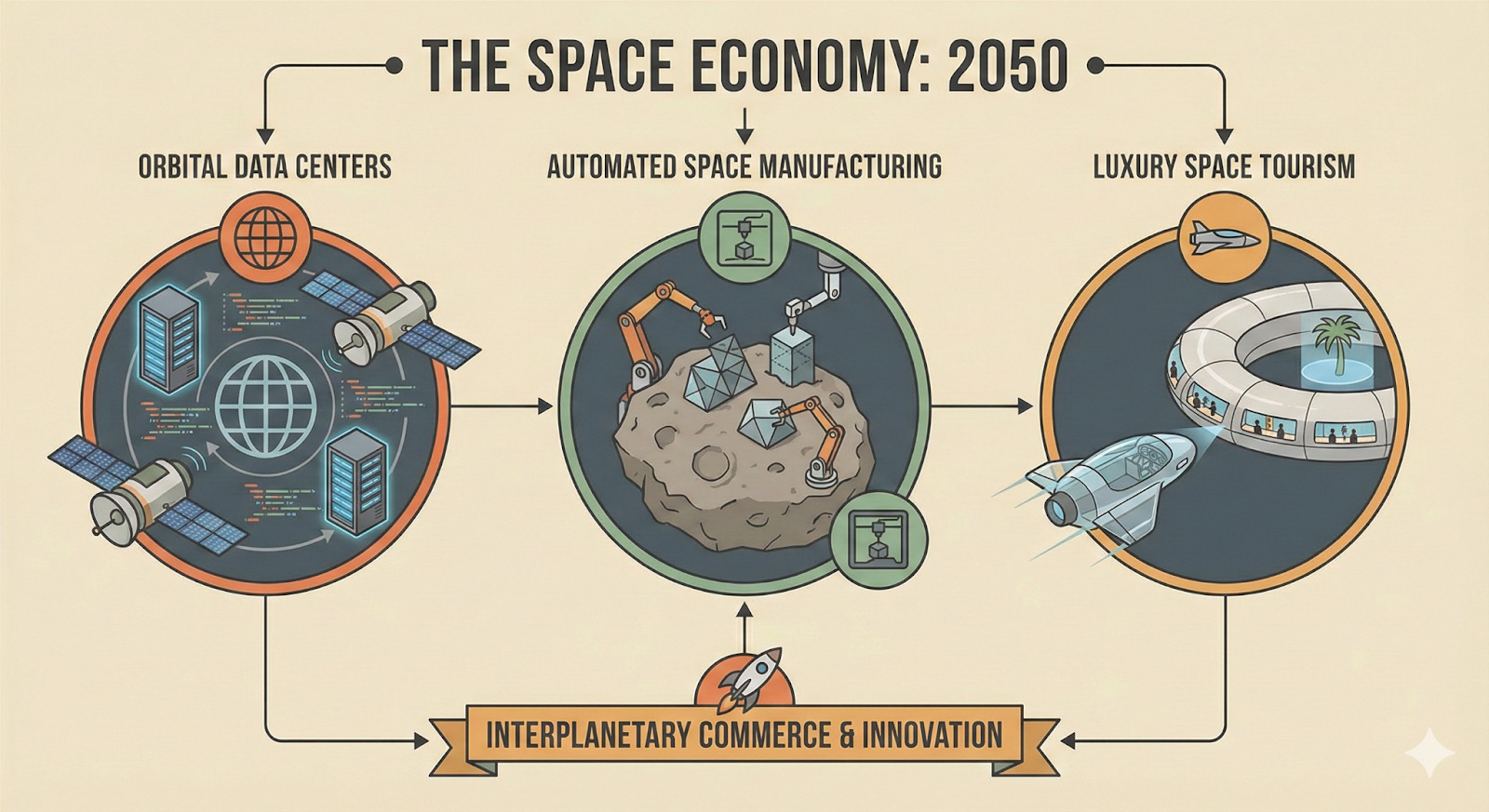
The replacement of most global telco infrastructure, AI compute, manufacturing facilities and more permanent outposts, including luxury hotels in orbit and on the moon, will be huge drivers of economic growth. All will be operated and maintained by an autonomous robotic workforce with embedded AI.
The space economy will already be worth $1.8 trillion by 2035. By 2050, asteroid mining and automated space manufacturing will have enabled humans to set foot on Mars and have a permanent outpost on the Moon.
Starlink and other constellations will provide high bandwidth, low latency internet globally. Only high-density urban cores will remain mainly connected by fiber. This globally available connectivity will birth many huge companies across data collection, teleoperation, and cellular industries.
SpaceX’s Starship will lower launch costs so drastically that orbital compute will be cheaper than terrestrial data centers, creating the biggest market opportunity in history. Trips to low Earth orbit and the Moon will become a status symbol and prized trip for every well-to-do family that winter in Aspen today.
The vast majority of ‘work’ in space will be done by robots. Asteroids will be mined, satellites serviced, and outer planets explored to great lengths by robotic workers.
A Brave New World
The most drastic changes we will experience in the next 25 years will likely be the most unforeseeable.
Here are some possibilities we’re thinking about for 2050 that would change everything:
A U.N. Security council member collapses due to internal conflict, causing the downfall of the United Nations and accelerating the shift to the multipolar era with no dominant power.
Many nuclear fusion power plants could be operating, creating abundant energy, plentiful food, and clean water for all 10 billion of us.
Breakthroughs in AGI, nanotechnology, and quantum mechanics lead to the invention of the teleporter. But the question remains: is it really you that is reassembled on the far side, or have you killed yourself in the process?
Complex multi-cellular life is discovered in the subsurface oceans on Europa, triggering mass hysteria as the Fermi Paradox becomes commonplace in conversation around the long-term survival of humanity.
The greenhouse effect could snowball and cause the tropics to become scorching, driving migration northward and southward and accelerating a global refugee crisis. Policy makers will turn to technology like SRT to buy time to gain control over our rapidly warming atmosphere.
The chasm between the tremendous demand for institutional senior care and the dwindling supply of young people will be so wide that it catalyzes social unrest between generations, sparking the seeds for the first major country revolutions in over a century. The youth-led revolution in Nepal is a harbinger of this potential trend.
The creation of superintelligence will usher in exponential leaps in productivity but also cultural upheaval. A state may choose to govern itself with a superintelligence, creating a new type of citizen and reshaping the social contract. This world is likely one of abundance, but when we have access to infinite resources - will we still fight over who has the most?
Breakthroughs in life-extension and BCIs may lead to a merging of man and machine. These advances could lead to the development of a new global religion centered around transhumanism. If we extend healthy lifespans into the 100+ range many of our demographic challenges will soften, but also what will a world of centenarians prioritise?
–
We write this Forecast partly to speculate, partly to inspire, partly for fun. The future is a place that we believe will be filled with wonder. But the challenges on the journey there are mighty. If you’re researching, building, or pondering any of the themes discussed here, we would love to hear from you.
Our first interview of the series will launch this coming Spring. We hope you’ll enjoy it!
With thanks to Tom McCarthy, Simon Custer, Robbie Osborne, Justin Gage, Patrick Mandia, Lola Wajskop and several others who contributed to this research and writing.
Great read! Very interesting.
Would throw in some more predictions for Europe. Europe has an even bigger aging population issue and no edge in any emerging industry. The increasingly old population votes for policies favoring themselves (keeping the retirement age the same, unsustainable pensions & healthcare, more debt), leading to a vicious cycle. People will have even fewer kids and politics will get a lot more extreme (on either side).
Industry-wise, Europe will lose a lot of industrial production capacity due to high labour costs and overregulation. R&D investments are already down massively.
Wonder what forces could counteract this development.
Amazing read